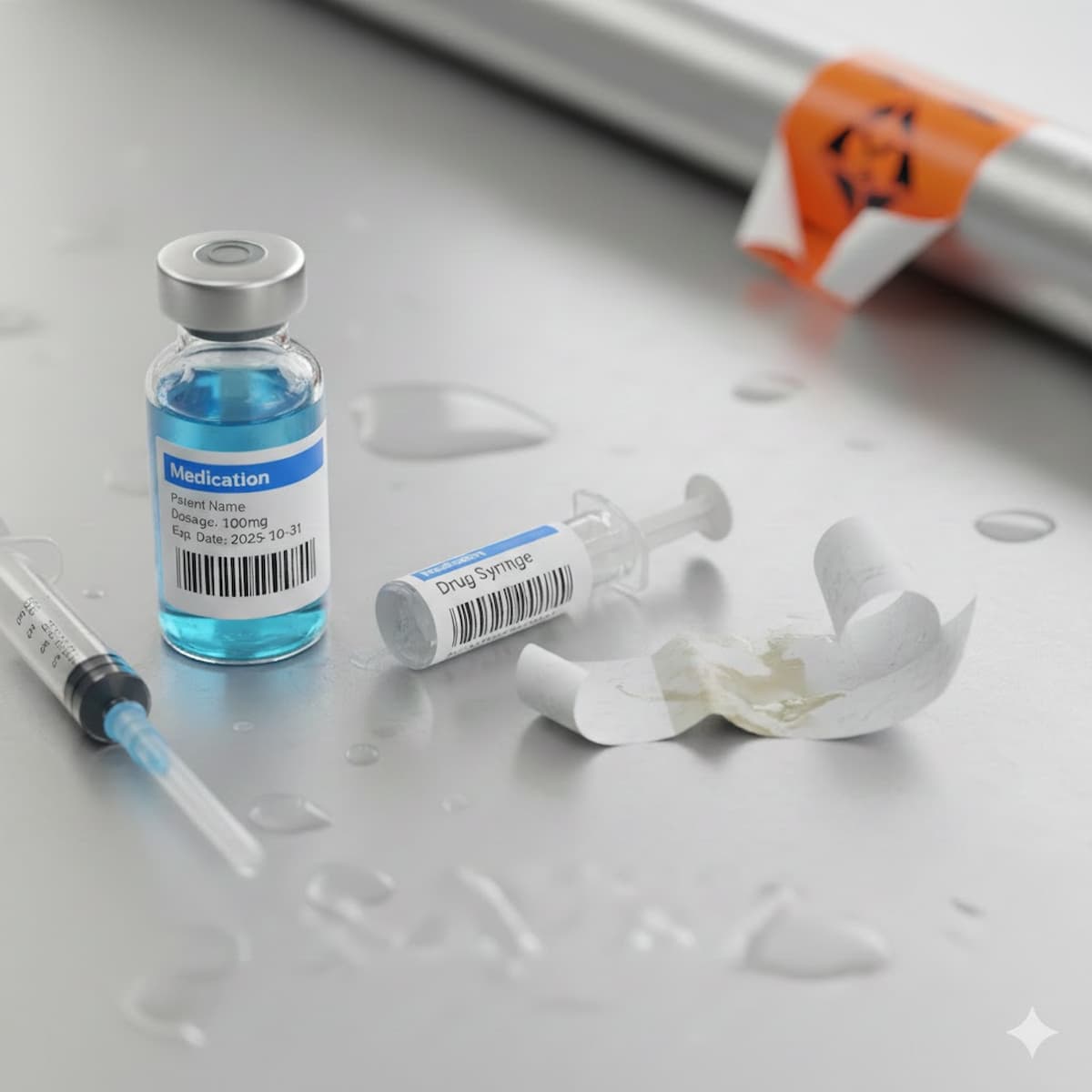
What’s more important to healthcare providers and veterinary practices, a label that guides safe administration or the life-saving technology itself? In reality, a proper label is inseparable from that technology. It delivers essential details like medication names, dosages, expiration dates, patient information, and barcodes. When a label fails, that critical information fails with it.
Label peeling is an all too common and costly failure. A label that lifts, curls, or detaches entirely can leave medication instructions unreadable, lead to dosing errors, or cause a specimen to be rejected. Understanding how to choose the right material and adhesive can avoid the issues that label peeling can cause.
The Compliance Risks of Peeling Labels
Peeling labels can trigger a cascade of issues that impact both patient care and regulatory standing:
- Lost or unreadable data - Medication names, barcodes, dosage instructions, and expiration dates can be lost if a label peels or falls off entirely.
- Sample or medication rejections - Labs, pharmacies, hospitals and veterinary practices often reject unlabeled or illegible specimens, which can lead to treatment delays.
- Regulatory non-compliance - Missing or unreadable labels can result in questions about regulatory or accreditation status, including a Joint Commission adverse decision, fines, or even legal action.
Imagine a scenario where a nurse prepares a refrigerated medication for a patient, but the label, due to unsuitable adhesive, detaches in the refrigerator or during retrieval. The nurse cannot confidently identify the medication or the patient it's intended for. This creates an immediate need to reorder the medication from the pharmacy, causing delays in treatment and potentially impacting the patient's condition, especially in urgent situations.
Read this blog post to learn how to select the label adhesive that best fits your application.
Common Causes of Peeling Labels
Labels peel away from surfaces due to a combination of factors that include:
- Incorrect adhesive selection - Using a standard adhesive on a curved vial, cold storage container, or moist surface can cause immediate lifting.
- Material compatibility – Labels that aren’t designed to resist moisture, temperature fluctuations, or abrasion will fail faster in demanding environments.
- Improper application – Applying labels to dirty, wet, or textured surfaces reduces adhesion.
- Environmental challenges – Factors like humidity, frequent handling, or storing containers in cold/freezer conditions can weaken adhesives.
- Label Storage Conditions - Storing labels in high humidity or extreme temperatures can degrade the adhesive and cause them to peel when applied later.
Best Practices to Prevent Peeling and Maintain Compliance
You can prevent the patient safety and compliance issues caused by label peeling by taking these steps:
- Match the adhesive to the application – Choose adhesives designed for specific surfaces such as vials, syringes, IV bags, or specimen tubes.
- Ensure the label material suits the application - moisture, chemicals, cleansers and frequent handling are common in healthcare and veterinary applications requiring labels that stand up in those demanding situations.
- Consider environmental conditions - Vials, syringes and IV bags are often labeled and then placed into a 38-degree refrigerator but administered in a 72 degree room. Label failures are more likely to occur when the label material and adhesives are incompatible with both the intended application and service conditions.
- Prepare surfaces properly - Ensure surfaces are clean and dry before applying a label.
- Test before rollout - Test labels in your environment to confirm performance.
UAL’s In-House Label Testing Lab: Built for Real-World Reliability
At United Ad Label, label materials are rigorously tested in our dedicated facility to ensure they meet the demands of your work environment. Our label performance center helps customers avoid costly trial-and-error by delivering labels that are validated to perform in critical environments. Our process includes:
- Simulated stress testing for heat, cold, moisture, and friction.
- Application testing on challenging surfaces like curved containers, textured materials, and cold-storage packaging.
- Performance validation for clinical and veterinary workflows before products ever ship.
The result? Labels that resist peeling and maintain legibility no matter the conditions.
Do you have a labeling application that could benefit from performance testing?
Case Study: Solving Adhesive Failures in Medication Flag Labels
A large health system was experiencing persistent problems with their medication flag labels. In refrigeration, labels with the wrong adhesive would either shift on the vial, making it difficult to see dosage levels, or adhere too strongly, obscuring important information. The system also used multiple flag label SKUs for similar functions, creating unnecessary inventory complexity and confusion among staff.
Working with United Ad Label the health system implemented a redesigned flag label that:
- Used an adhesive engineered for cold storage, preventing shifting or over-adhesion.
- Combined multiple label functions into one design, reducing SKUs and streamlining inventory.
- Incorporated a perforated section for multi-dose use or as a detachable record for patient files.
The result was a durable, compliant label that performed reliably in refrigeration, improved medication visibility, simplified workflows, and eliminated the waste associated with unused labels.
Learn All the Details in This Case Study
Beyond Healthcare: OSHA & Safety Label Implications
Peeling labels aren’t just a healthcare problem. The heat, cold, humidity, chemicals and handling issues are common in industrial environments as well. And when OSHA-mandated safety labels and hazard warnings peel or fall off it can lead to:
- Worker injuries due to missing safety instructions.
- Regulatory violations and fines.
- Increased liability in accident investigations.
Durable adhesives and materials are essential for safety compliance across every industry.
Invest in the Right Labels for Lasting Compliance
Peeling labels are more than a nuisance, they are a preventable compliance risk. With the right adhesives, high-quality materials, and expert consultation, you can ensure that every label you apply stays in place and readable for its full intended lifespan.
United Ad Label offers labeling solutions designed and tested for performance under real-world conditions. Our team can help you select the right materials and adhesives for your environment, which allows you to focus on patient care, safety, and compliance without worrying about label failures. Contact us to find the right solution for your specific environment.